
HLP Skunk #1 Case Study Report
Humboldt Legacy Project est 2020
What can one cannabis cultivar teach us about genetics, history, environment, culture, and responsibility?
The Humboldt Legacy Project Skunk #1 Case Study follows one preserved cultivar through historical research, community knowledge, scientific testing, cultivation across different environments, and consumer research.
The project began with a larger question:
How can cannabis genetics, knowledge, history, and value be documented and carried forward without separating them from the people and communities that preserved them?
The Skunk #1 case study is the first full research project developed through the Humboldt Legacy Project, an initiative of Humboldt Grace.
🎧 Let the Plant Speak 🎧
A Real-World Cannabis Case Study
The project began in 2020 after two preserved Skunk #1 selections were donated to Humboldt Grace.
Over the following years, participants contributed cultivation knowledge, historical documentation, laboratory testing, genetic research, consumer feedback, preservation work, and professional review. The project examined:
Why This Work Matters
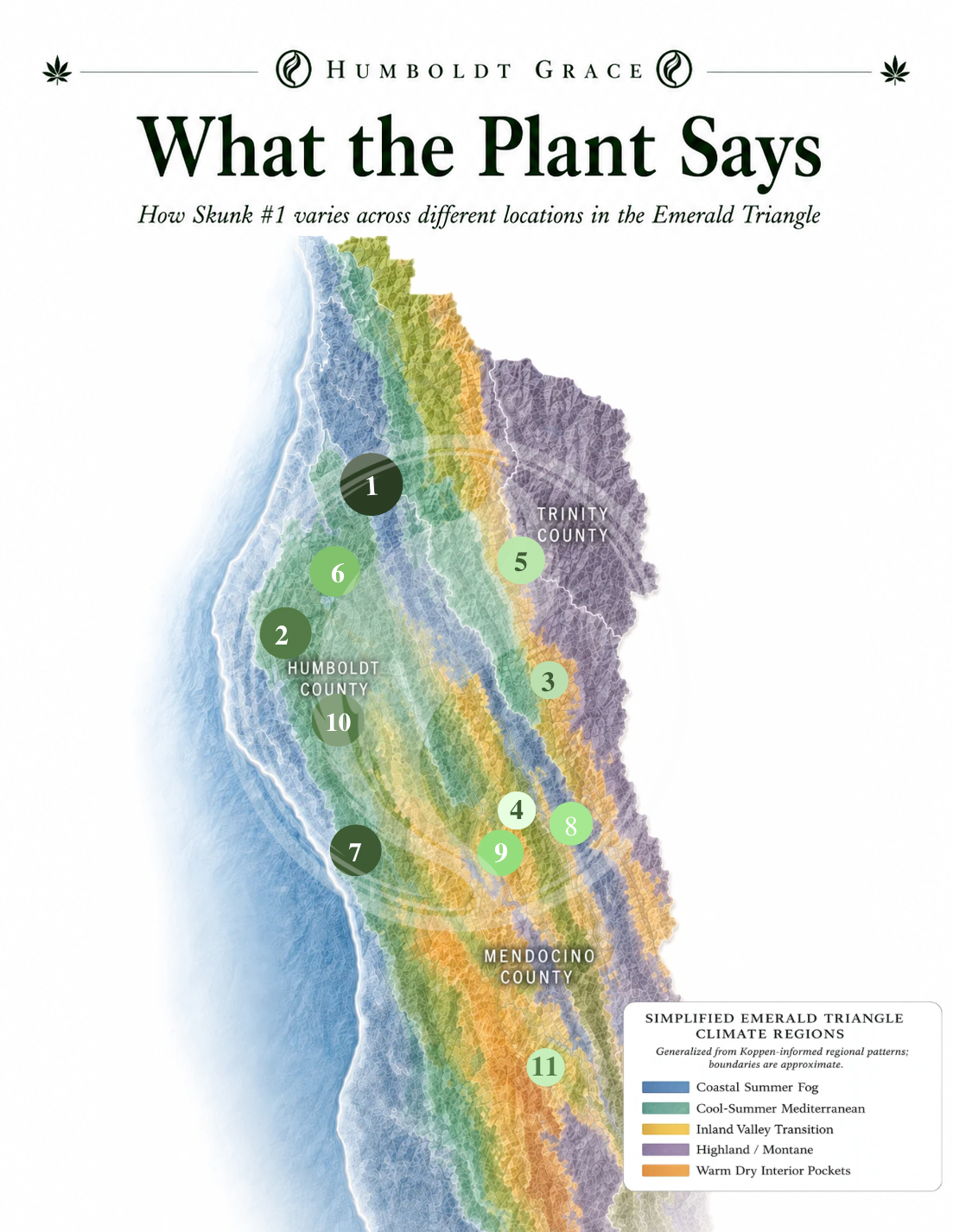
Note: Farm locations shown on this map are estimated and do not reflect all project data points. © 2026 Lelehnia Dubois, Founder of Humboldt Grace, a Dreammaker Project of the Ink People 501c3. This map is copyrighted and may not be reproduced separately or in full without permission from Humboldt Grace.
Cannabis legalization created new markets, but it did not create the plant, the knowledge surrounding it, or the communities that preserved it.
Without better documentation and ethical standards, important genetics may be lost. Histories may be separated from the people who lived them. Cultivars may be renamed, claimed, or commercialized without meaningful attribution. Scientific findings may be presented with more certainty than the evidence supports.
The Skunk #1 case study does not claim to solve every question surrounding cannabis genetics or ownership.
It demonstrates a process for asking better questions, building a stronger record, identifying limitations, and bringing scientific information into conversation with history, cultivation knowledge, consumer experience, and community responsibility.
Who this report is for?
The Skunk #1 Case Study Report was created for people working across the entire cannabis ecosystem, including, but not limited to:
- Farmers and breeders seeking better systems for documenting genetics and stewardship. Loooking for data to supporting marketing.
- Scientists and laboratories examining how one plant expresses in different environaments.
- Brands and businesses working with genetics, origin stories, appalachians. and legacy claims.
- Researchers and educators studying cannabis history, chemistry, genetics, policy, or culture.
- Policymakers developing rules that affect genetic resources, traditional knowledge, rural communities, appalachians, commercial ownership, and how a plant reacts in different cultivations.
- Consumers who want to better understand what exists behind a cultivar name.
- Legacy communities seeking practical ways to document, protect, and receive recognition for the knowledge they carried forward.
HLP Skunk #1 Case Study Report
The HLP Skunk #1 Case Study is now being released.
Our offical purchasing link through the Ink People is still being completed, but you do not have to miss the launch or lose access to the introductory pricing.
Reserve your copy today, and we will send the secure purcashing link directly to you as soon as it becomes avaible. Everyone who joins the reservation list during the launch period will recive the launch price.
From Genetics to Ethics
The Skunk #1 case study is one part of a larger body of work.
The Humboldt Legacy Project began by examining how a single cultivar could be documented through preservation, history, cultivation, science, and community participation.
The Humboldt Grace Cannabis Ethics Survey expands the inquiry.
It asks people across cannabis culture, science, medicine, business, regulation, public safety, and community life to identify the values, harms, responsibilities, and ethical standards that should guide the future of cannabis.
Together, these projects explore three connected questions:
What are we carrying forward?
How do we know what it is?
What responsibilities come with using it?

About the Humboldt Legacy Project
Humboldt Grace works to empower rural communities affected by the drug war while honoring the people, plants, knowledge, and culture that helped shape cannabis history.
The Humboldt Legacy Project brings together community knowledge, historical research, scientific tools, cultivation experience, ethical inquiry, and public education.
Its purpose is not to place one form of evidence above all others.
Its purpose is to understand how different forms of knowledge can work together to create a more accurate, responsible, and useful record.


Frequently Asked Questions
Does the report genetically authenticate Skunk #1?
No. The project uses the term DNA-supported lineage research.
Genetic testing helped document characteristics and supported comparisons to the Weiblen 2012 study. However, DNA alone cannot establish the complete identity, creator, ownership, history, or cultural meaning of a cultivar.
Does the report reveal participating farm information?
The public materials are designed to protect confidential and personally identifying participant information. Farms are not connected to private data without permission.
Can I share the report ?
Yes please share it, we did for everyone. However if you monitize it or its contents, and/or wish to repurpose it for insitutional pusrposes, email lele@humboldtgrace.org for licensing options. This report has been copyrighted.
Please cite for research, journalism, education, or commentary using proper attribution. Citation does not include permission to reproduce substantial portions of the report, its graphics, or its data.
@Lelehnia Dubois Founder Humboldt Grace a Dreammaker of the Ink People 501(c)3
Should the report be cited?
Yes. The report may be cited for research, journalism, education, or commentary using proper attribution. Citation does not include permission to reproduce substantial portions of the report, its graphics, or its data.
@Lelehnia Dubois Founder Humboldt Grace a Dreammaker of the Ink People 501(c)3
Can an organization purchase access for multiple people?
Yes. Commercial and institutional licenses are available for organizations that need team access, internal use, presentations, professional research, or training.
Where does the money go?
Revenue supports report production, project administration, public education, preservation work, and future research conducted through the Humboldt Legacy Project and Humboldt Grace.
Carry the Knowledge Forward
This project was made possible because farmers, researchers, laboratories, historians, advisors, community members, consumers, and preservation partners were willing to contribute what they knew.
The report is not only about what was learned from one plant.
It is about what becomes possible when people show up to build a record together.
Humboldt Legacy Project
An initiative of Humboldt Grace
www.humboldtgrace.org
@humboldtgrace
Lele@humboldtgrace.org